
Benefits of Medical Grade Facials: What Your Skin May Gain
The benefits of medical grade facials depend less on the label and more on whether the treatment suits your skin, concerns and tolerance. A useful starting point is to understand what the treatment is designed to address and how it fits with your existing routine.It’s understandable to want clearer,...

The benefits of medical grade facials depend less on the label and more on whether the treatment suits your skin, concerns and tolerance. A useful starting point is to understand what the treatment is designed to address and how it fits with your existing routine.
It’s understandable to want clearer, smoother-looking skin while feeling cautious about irritation, downtime or promises that sound too good to be true. A clinical facial may offer a more considered approach than a standard salon treatment, with professional guidance and products selected for individual needs. Results vary, and no facial can guarantee a particular outcome.
This article explains what “medical grade” can mean, how clinical facials compare with salon treatments and home care, and which skin goals a tailored approach may support. It also covers how to discuss sensitivity and recovery, and why consistent sun protection matters as part of everyday skin care in Brisbane.
At ZABÉ Cosmetic in Albion, Brisbane, personalised dermal therapies featuring Rationale form part of individualised aesthetic care. A considered approach connects your skin goals with suitable care and a manageable home routine, rather than relying on a one-size-fits-all formula.
Key Takeaways
• The benefits of medical grade facials depend on how well the treatment and product choices align with your skin’s needs, not the label alone.
• Clarify your skin goals, current routine and sensitivities to help shape a considered approach to professional care and home skincare.
• Compare clinical and salon facials by their purpose, assessment and degree of personalisation, not simply by the setting.
• When considering a facial in Brisbane, include local heat, humidity and sun exposure in your broader skin-care routine.
• Personalised dermal therapies featuring Rationale skincare can form part of an individualised approach at ZABÉ Cosmetic in Albion.
What are the benefits of medical grade facials?
A clinical facial is a skin-focused treatment informed by your concerns and needs. A standard facial may focus more on relaxation and general skin care. The distinction isn’t simply the setting or the words used to describe the service. A considered approach takes your goals and sensitivities into account when selecting suitable products and treatment steps.
Medical-grade facial care is an individually planned skin treatment informed by professional guidance, not a result guaranteed by a label. Potential benefits include more considered product selection, a clearer understanding of your skin’s current needs and care directed towards a specific goal. That can be more useful than choosing a treatment based on a trend or an appealing name.
The word “facial” covers a range of meanings and treatments, as the general Facial (disambiguation) page illustrates. “Medical grade” is also used differently across clinics and skincare ranges in Australia. The phrase alone doesn’t establish that treatments share the same ingredients, devices, practitioner qualifications or protocols. It’s more useful to understand how the care is planned and whether it fits your needs.
What does medical grade mean in a facial?
In practice, the term may describe professional skincare, a treatment delivered in a clinical setting or a facial that includes a structured skin assessment. Those details vary. A more meaningful distinction is whether your goals, sensitivities, current routine and suitability are considered before treatment steps are selected. The label itself doesn’t prove that a treatment is more appropriate or effective for everyone.
Which skin goals may clinical facials support?
Depending on the treatment and your individual response, a clinical facial may support the appearance of dullness, uneven texture or dehydration. Product choices and treatment steps can be tailored to the concern being addressed rather than applied as the same routine for every skin type. Visible changes aren’t assured or permanent. They can depend on your skin, the approach selected and consistency with suitable home care.
Before treatment, describe what you’d like to improve and mention any sensitivities or reactions you’ve experienced. This gives the practitioner useful context when considering a suitable approach and helps keep expectations realistic. More intensive doesn’t automatically mean better. Comfort and appropriateness matter.
Tailored selection
Products and treatment steps can be chosen with your skin goals and sensitivities in mind.
Structured assessment
A considered review can help identify priorities and inform the treatment plan.
Targeted care
The approach may focus on concerns such as visible dullness, uneven texture or dehydration.
These are potential benefits, not promises. Results vary according to skin condition, treatment choice, consistency and individual response. A facial is not a substitute for assessment of a persistent or diagnosed skin condition. If a concern is ongoing, changing or causing discomfort, seek appropriate medical assessment rather than relying on a cosmetic facial to diagnose or treat it.
How do medical grade facials support a considered skin routine?
A well-planned facial is one part of a wider skin routine, not a replacement for it. Start by clarifying your goals and current routine, then consider which professional approach makes sense for your skin. This connects in-clinic care with practical steps at home instead of treating every appointment as a standalone experience.
Good skin planning brings assessment, tailored treatment and realistic expectations together, then supports them with consistent care at home. This is a more useful way to consider the benefits of medical grade facials than expecting one session to resolve every concern. The treatment may be focused, while the routine around it remains part of your ongoing approach.
Why does skin assessment matter before treatment?
Your skin’s needs can be influenced by sensitivity, the products you currently use, your concerns and relevant history. Sharing these details helps inform a suitable plan and may highlight reasons to adjust the treatment or take a more conservative approach. This is educational context, not a diagnosis. An approach that suits one person may not suit another, even when their goals are similar.
To prepare, note which products you use, how often you apply them and whether you’ve experienced irritation or unexpected reactions. Be specific about what you’d like to address, too. “Better skin” is a broad goal; comfort, hydration or the look of uneven texture gives the discussion a more practical starting point.
How can professional products fit into home care?
Professional product selection can complement your existing routine rather than replace it. A practitioner can help you consider which steps are relevant, how they fit together and whether a simpler routine would be easier to maintain. In Albion, Brisbane, ZABÉ Cosmetic’s personalised dermal therapies feature Rationale skincare. Products are considered as part of individualised aesthetic care, without a promise of a particular result.
Consistency matters, but a routine doesn’t need to be complicated. A considered plan may focus on a small number of suitable steps you can maintain, alongside any care guidance provided after treatment. In Brisbane, regular sun protection is also an important everyday habit. It supports general skin care, but it isn’t a treatment-specific effect and can’t guarantee a cosmetic outcome.
It’s also helpful to distinguish topical dermal care from injectable skin treatments. They are different approaches, with different considerations and planning. For an overview of the latter, consult professional clinical guides and resources. Keeping those categories clear helps you understand what a facial is intended to do, and what it isn’t.
Before treatment
Share your goals, current products, sensitivities and relevant history.
After treatment
Follow the guidance provided and keep home care consistent and manageable.
Over time
Review whether the approach still fits your skin and priorities.
If you’re considering how professional skin guidance could fit into your routine, explore personalised dermal care at ZABÉ Cosmetic.
Medical grade facial vs salon facial vs at-home skincare
These options can serve different purposes, and none is automatically right for everyone. A clinical facial may suit someone seeking structured guidance around an appearance-related concern. A salon facial may focus on relaxation and general skin maintenance, while home care offers a familiar way to look after your skin day to day.
Compare the approach rather than assuming one setting is always superior. The benefits of medical grade facials may include an in-person assessment and care selected around your goals. Their value depends on whether that approach suits your skin, preferences and expectations.
Aspect | Clinical facial | Salon facial | At-home skincare
Assessment | May include a structured discussion of skin goals, sensitivities and current products. | Often considers immediate skin preferences and the treatment experience. | Guided by your own observations; usually no in-person professional assessment.
Personalisation | Treatment choices may be shaped around individual needs and suitability. | Steps may be adapted to the service and your preferences. | You select and adjust products for your routine.
Setting | A clinical environment, with care focused on skin goals. | A salon setting that may prioritise relaxation and general care. | At home, at a time that suits you.
Ongoing care | Can inform a home routine, but doesn’t replace it. | May complement regular personal care. | Supports consistency between professional appointments, if you have them.
When might a clinical facial be worth considering?
It may be worth considering if you’d like structured guidance for a specific appearance-related goal, such as the look of uneven texture or dullness. An in-person conversation allows you to discuss sensitivities, the products you use and how your skin has responded to previous treatments. A clinical facial isn’t essential for healthy skin. The right choice depends on your priorities and comfort.
What can a salon facial or home routine offer?
A salon facial can be a suitable choice if you’re seeking relaxation or general skin maintenance. Home skincare offers a practical way to maintain regular habits without an appointment. Both can have a place in a broader routine, and clinical care doesn’t need to replace either. Your preferred balance may depend on your goals, budget and how much guidance you’d find useful.
Think of each option as serving a different role. Professional care may help you make more informed choices, while a manageable home routine supports consistency. A facial is one part of skin care, not a requirement or a substitute for everyday habits.
Choosing a medical grade facial in Brisbane: fit, climate and expectations
A considered choice starts with your needs, not a treatment name. In Brisbane, it also makes sense to discuss how sun exposure, heat and humidity fit into your everyday skin-care habits. These details can help make a plan relevant to your routine, but they don’t determine which facial is right for you. Personalised guidance can connect your goals with an approach that feels appropriate and realistic.
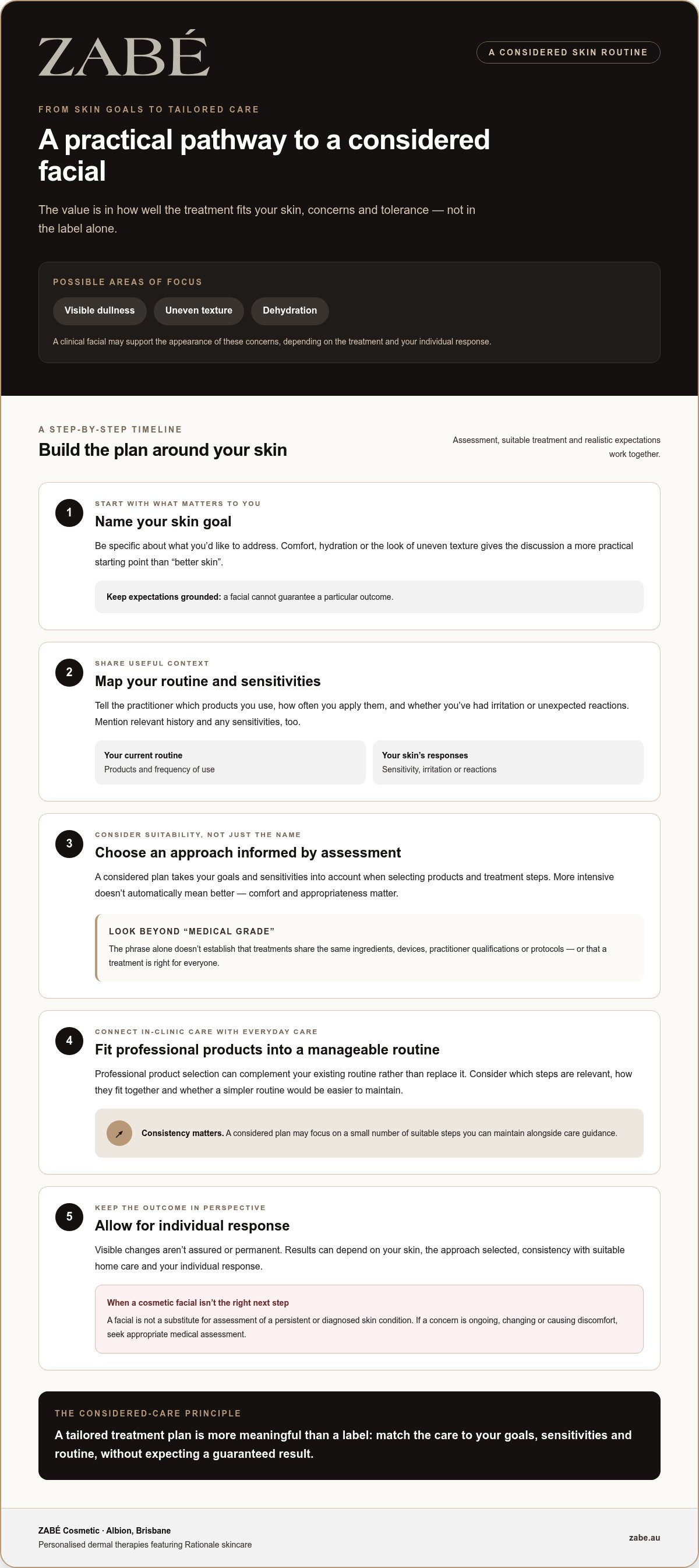
Use this simple sequence to prepare:
Clarify your goal.
Describe what you’d like to address, such as the appearance of dullness or uneven texture.
Discuss your current routine.
Bring the names of products you use, including active ingredients, if known.
Review suitability.
Talk through sensitivities, previous treatment responses and any recent procedures.
Agree on expectations.
Understand the intended focus of the treatment and what outcomes are realistic for you.
What should you discuss during a skin consultation?
Be open about what matters to you and what feels comfortable for your skin. Mention products that have caused irritation, your usual routine and any previous facial or skin treatment experiences. If you’ve recently had a procedure, include that in the conversation rather than assuming it’s irrelevant. These details help shape an individualised aesthetic and dermal care plan. They don’t replace medical assessment when a diagnosed or persistent concern needs attention.
Share practical preferences, too, such as wanting a gentle approach or needing to keep your routine manageable. Your plan should reflect your skin needs and comfort, not simply follow a standard protocol. The aim is to discuss a suitable option and set expectations without promising a particular result.
How should Brisbane conditions shape skin-care conversations?
Brisbane’s warm, humid conditions and regular sun exposure can influence everyday choices, from how comfortable products feel to how consistently you use sun protection. Mention how much time you typically spend outdoors and which products you use during the week. This context can make skin-care discussions more relevant to your routine, without suggesting the climate causes a specific skin condition or that a facial can prevent sun-related damage.
Sun protection remains part of everyday skin care, separate from the effects a particular facial may offer. A treatment plan can consider local conditions, but it doesn’t replace sun-safe habits or medical advice for a skin concern. The benefits of medical grade facials are best considered in relation to your goals, the approach selected and your individual response.
ZABÉ Cosmetic’s personalised dermal therapies in Albion, Brisbane, feature Rationale skincare as part of individualised aesthetic care. A tailored plan brings your skin goals, comfort and home routine into the same conversation. Explore ZABÉ’s personalised dermal therapies to learn about this approach.
For a considered next step, explore personalised dermal therapies at ZABÉ Cosmetic.
Personalised dermal therapy at ZABÉ Cosmetic
Skin care is most useful when it reflects the person, not just a product label or popular treatment. ZABÉ Cosmetic is a specialised aesthetic and longevity clinic in Albion, Brisbane, offering personalised aesthetic and dermal care. Its dermal therapies feature Rationale skincare and form part of an individualised approach to skin goals.
This perspective helps put the potential benefits of medical grade facials into context. Rather than expecting a dramatic change from one treatment, consider how professional skin guidance, suitable dermal care and an achievable home routine may work together. The focus is thoughtful planning, clear explanations and realistic expectations for your skin.
A considered approach to dermal therapies
Your priorities are a useful starting point. You might discuss the appearance of dullness, uneven texture or another skin goal, alongside how your skin feels and what you currently use at home. Sharing sensitivities and previous experiences can make the discussion more personal. These details provide context for considering an approach that suits your needs and comfort.
ZABÉ’s dermal therapies feature Rationale skincare as part of personalised aesthetic care. Product selection is one part of the broader discussion, not a promise of a particular result. A considered plan should make clear what the care is intended to address, how it relates to your priorities and what limitations to keep in mind. No single product or treatment suits everyone.
Useful questions to bring to a skin-care discussion include:
• Which skin goals matter most to me?
• What products do I use, and how does my skin respond to them?
• How might professional dermal care fit alongside the routine I can maintain?
• What outcomes are realistic, and what factors could affect my response?
Taking the next step with confidence
The comparison between clinical care, salon facials and home skincare can help you decide what kind of support you’re looking for. If your priority is relaxation, a salon facial may suit that purpose. If you want individualised guidance around skin goals, a discussion about dermal care may be a more relevant starting point. Neither choice is a requirement for healthy skin. The right fit depends on your preferences and needs.
Bring your priorities, current routine and any sensitivities into the conversation. Clear information helps shape a considered plan, while an honest discussion of expectations keeps the focus on appropriate care rather than dramatic promises. Ongoing home habits remain part of the picture, too.
For a closer look at ZABÉ Cosmetic’s personalised aesthetic and dermal care in Albion, Brisbane, discover ZABÉ Cosmetic.
Choose a skin-care path that feels right for you
Your next step doesn’t need to be a commitment to a particular treatment. Start by identifying what you’d like your skin care to support, what feels comfortable and how much change you’re hoping for. Those priorities can guide a useful conversation about whether professional dermal care fits alongside your existing routine.
The potential benefits of medical grade facials are best considered in the context of your skin and expectations. A measured approach leaves room to ask questions, understand the intended focus of care and decide what feels appropriate, without pressure to pursue more than you need.
If you’re ready to explore a considered approach to your skin goals, explore personalised dermal care at ZABÉ Cosmetic. Take your time, keep expectations realistic and choose the next step with confidence.
Frequently Asked Questions
What is the difference between a medical grade facial and a regular facial?
A medical grade facial typically places greater emphasis on skin-focused planning, while a regular facial may be chosen mainly for relaxation or general maintenance. The name alone doesn’t tell you exactly what happens during a treatment, as approaches differ. Before deciding, find out what the treatment is designed to address, what steps it involves and whether the plan accounts for your skin’s sensitivities and current routine.
Are medical grade facials worth it for sensitive skin?
They may be worth discussing if you have sensitive skin, but suitability depends on the specific treatment and your individual response. Share what tends to cause discomfort, any reactions you’ve experienced and the products you’re currently using. This gives the practitioner useful context to consider a measured approach. If your skin is unusually uncomfortable or your sensitivity is persistent, seek appropriate medical advice rather than relying on a cosmetic facial to assess the cause.
How often should you have a medical grade facial?
There isn’t one schedule that suits everyone. Appropriate timing depends on the treatment selected, your skin’s response, your goals and how the care fits with your home routine. Rather than booking repeated sessions by default, discuss what the treatment plan is intended to achieve and when it makes sense to review progress. If your skin feels unsettled after treatment, seek personalised guidance before arranging another session.
Can medical grade facials improve skin texture and dullness?
They may help improve the appearance of uneven texture or dullness, depending on the approach and your skin’s response. The benefits of medical grade facials aren’t identical for everyone, and visible changes may be subtle or temporary rather than permanent. For a useful comparison, note how your skin looks and feels before treatment, then discuss any changes at a review instead of relying on memory alone.
Do medical grade facials involve downtime?
Downtime varies with the treatment and the way your skin responds, so don’t assume every facial has the same recovery experience. Before proceeding, clarify what you might notice afterwards and whether treatment could affect plans such as work, exercise or a social event. If you’ve had a recent procedure or have an important occasion coming up, mention it during the discussion so timing can be considered.
Are medical grade facials suitable for Brisbane's climate?
They can be considered in Brisbane, but local heat, humidity and sun exposure are useful context for discussing your routine and skin-care preferences. Mention how often you’re outdoors and which sun-protection products you use. These details can inform a relevant conversation, but climate alone doesn’t determine whether a facial suits you. Keep sun protection part of everyday care, separate from any treatment-specific effects.