
Rejuran or Hyaluronic Acid Fillers: Which Should You Choose
A treatment that adds volume isn’t necessarily the right choice for improving skin quality. In a Rejuran vs hyaluronic acid fillers comparison, the key difference is purpose: Rejuran is a polynucleotide injectable intended to support skin repair and texture, while hyaluronic acid fillers add or rest...

A treatment that adds volume isn’t necessarily the right choice for improving skin quality. In a Rejuran vs hyaluronic acid fillers comparison, the key difference is purpose: Rejuran is a polynucleotide injectable intended to support skin repair and texture, while hyaluronic acid fillers add or restore volume and can shape contours. They aren’t interchangeable, and neither is automatically the better choice.
It’s understandable to want to address hollows, fine lines or uneven texture without creating a result that feels too full. This guide explains how these treatments differ, how their potential roles in skin repair and hydration translate in practice, and what injection risks to consider. It also covers when they may be used in combination: wait at least three months after cross-linked hyaluronic acid dermal filler before having Rejuran. The decision starts with your concern, whether volume or skin quality is the priority, and how previous procedures affect the plan.
Key Takeaways
• Define whether your main concern is skin texture, hydration or facial contour before considering a treatment approach.
• Understand the different roles of skin boosters and dermal fillers so you can weigh what best aligns with your goals.
• Account for possible injection effects, including bruising, swelling and infection, when considering either treatment.
• Factor in previous procedures and treatment timing when exploring whether Rejuran and fillers could be used together.
Does Rejuran® Offer Healing and Repair properties?
Rejuran and hyaluronic acid treatments serve different goals: skin quality and repair support versus hydration or facial volume. The right comparison starts with the concern being treated.
Uses for skin concerns
Rejuran may suit concerns such as fine lines, uneven texture and acne scars, where skin quality is the focus. Dark circles can have different causes, so Rejuran isn’t a guaranteed solution for every under-eye concern. Hyaluronic acid fillers restore facial volume, while skin boosters place small amounts of hyaluronic acid within the skin to support hydration rather than reshape contours.
Polynucleotide composition and proposed effects
Rejuran is an injectable gel made from polynucleotides derived from wild salmon DNA fragments. It doesn’t contain hyaluronic acid and isn’t a dermal filler. Its proposed effects relate to supporting skin repair and texture, rather than adding the volume that hyaluronic acid fillers provide. Hyaluronic acid attracts and holds water, which helps explain its role in fillers and hydration-focused skin boosters.
Healing and elasticity support
Rejuran is intended to support the skin’s repair processes and collagen production, with potential benefits for elasticity and texture. That differs from replacing volume: filler changes contours by adding gel, while Rejuran focuses on skin quality. Rejuran alone isn’t designed to address deep wrinkles, severe photoaging or more pronounced skin laxity, so these concerns need a different treatment assessment.
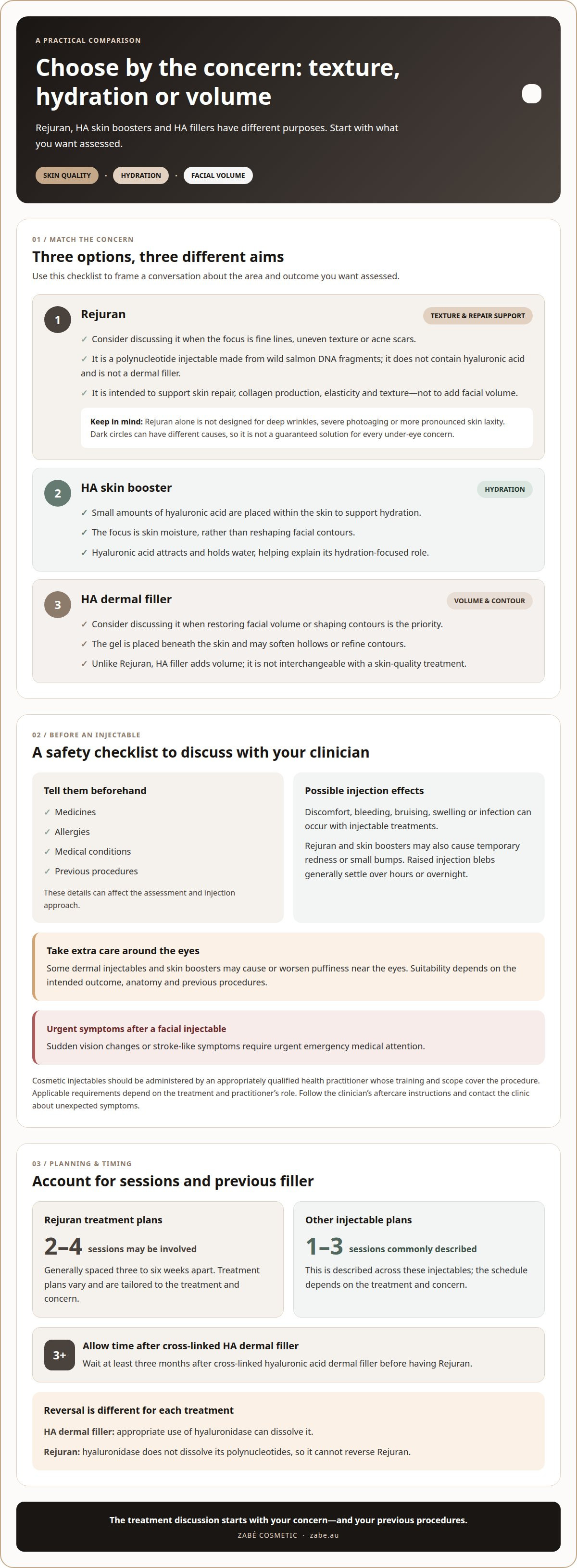
How do I choose? Match the treatment to your main goal: consider Rejuran for texture or scars, a skin booster for hydration, and filler when restoring volume is the priority.
What Australian rules apply? Cosmetic injectables should be administered by an appropriately qualified health practitioner whose training and scope cover the procedure. Applicable requirements depend on the treatment and practitioner’s role.
How many sessions are typical? Treatment plans vary. Rejuran may involve two to four sessions, generally three to six weeks apart. One to three sessions are also commonly described across these injectables, with the schedule tailored to the treatment and concern.
| Option | Main purpose | Focus |
|---|---|---|
| Rejuran | Repair support | Texture and elasticity |
| HA skin booster | Hydration | Skin moisture |
| HA filler | Volume | Facial contour |
Choose by matching the treatment’s purpose to your main concern.
What are dermal fillers?
An HA dermal filler is a gel placed beneath the skin to restore or shape facial volume. Hyaluronic acid attracts and holds water, so filler can soften hollows or refine contours. Rejuran is an injectable gel made from polynucleotides derived from wild salmon DNA fragments. The Rejuran vs hyaluronic acid fillers comparison is about different purposes, not simply different products.
That distinction matters when your appearance goals are specific. Someone seeking more definition in a facial contour may be considering filler, while a person concerned about uneven texture or acne scars may be more focused on Rejuran. The Rejuran vs hyaluronic acid fillers choice depends on whether volume or skin quality is your main concern.
Rejuran’s polynucleotides are intended to support skin repair and collagen production. This approach focuses on skin condition and texture rather than adding gel to create volume. HA filler, by contrast, is placed in selected areas to alter contours or replenish volume. HA skin boosters also use hyaluronic acid, but aim to support hydration rather than reshape the face.
A medical consultation and assessment should connect the treatment to the concern being addressed. The clinician considers the area, skin quality, desired appearance and previous procedures, then discusses whether volume, hydration or texture is the priority. For example, an acne scar may prompt a discussion about skin quality, while a hollow caused by volume loss raises a different treatment question.
What is Rejuran compared with HA filler? Rejuran is a polynucleotide injectable intended to support skin repair and texture; HA filler adds volume or shapes contours. Their ingredients and purposes differ, so the choice depends on the concern being treated.
Can HA filler be dissolved, and can Rejuran be reversed? Appropriate use of hyaluronidase can dissolve HA dermal filler. Hyaluronidase doesn’t dissolve Rejuran’s polynucleotides, so it can’t reverse Rejuran.
For a considered discussion of skin quality and treatment suitability, explore a Rejuran treatment assessment.
Injection risks and complications
Rejuran, hyaluronic acid fillers and skin boosters all involve injections, so each carries procedure-related risks. Possible effects include discomfort, bleeding, bruising, swelling or infection. Rejuran and skin boosters may also cause temporary redness or small bumps; raised injection blebs generally settle over hours or overnight.
Placement depends on the treatment and area. Rejuran may be injected up to the eyelids, while hyaluronic acid fillers are used in selected areas of the face and body. Under-eye treatment needs particular care: some dermal injectables and skin boosters may cause or worsen puffiness near the eyes. The intended outcome, anatomy and previous procedures help determine whether an injectable is suitable.
Before treatment, tell the clinician about your medicines, allergies, medical conditions and previous procedures. These details can affect the assessment and injection approach. Follow the clinician’s aftercare instructions, and contact the clinic about unexpected symptoms. Sudden vision changes or stroke-like symptoms after a facial injectable require urgent emergency medical attention.
Who should avoid Rejuran or HA fillers, including during pregnancy or breastfeeding? Suitability depends on individual circumstances and a medical assessment. If you’re pregnant or breastfeeding, raise this before treatment so the clinician can discuss your circumstances and whether to defer an elective injectable.
Risk depends on the area treated and your health history, not simply on whether the product contains hyaluronic acid or polynucleotides. Collagen support, hydration and volume correction describe different treatment aims; they don’t remove the risks associated with injections. A clinician’s assessment should account for the specific product, planned injection site and relevant medical details.
After treatment, monitor the area and follow the instructions provided. Mild bruising or swelling can occur, but severe or unexpected symptoms need prompt attention. If you experience vision changes or stroke-like symptoms, seek emergency help immediately rather than waiting for routine follow-up.
Combining Rejuran and dermal fillers
Rejuran and hyaluronic acid dermal fillers can address different concerns within a broader rejuvenation plan. Filler targets volume and contour, while Rejuran focuses on skin quality. Combining them doesn’t mean they should be injected together or treated as interchangeable. The sequence matters, particularly if cross-linked hyaluronic acid filler has already been placed.
Wait at least three months after cross-linked hyaluronic acid dermal filler before having Rejuran. This interval is a practical planning point, not a reason to add Rejuran automatically. A clinician’s assessment considers the filler treatment, the area involved, your current concerns and whether skin rejuvenation is an appropriate next step.
For example, someone seeking cheek definition and improved skin texture has two distinct goals. Dermal filler may address the desired contour, while Rejuran may be considered separately for texture. Planning each treatment around its purpose helps distinguish volume changes from skin-quality goals. It also allows the plan to account for previous injectables and their placement.
Discuss recovery and treatment timing as part of the plan. Injectable procedures can cause bruising, swelling or other local effects, so scheduling depends on the treatment areas and your circumstances. The three-month interval applies specifically after cross-linked hyaluronic acid dermal filler and before Rejuran; it isn’t a universal schedule for every combination.
The key takeaway is to plan around treatment goals and sequence, rather than choosing both treatments simply because they may complement one another. A medical assessment can review previous procedures, desired volume or contour, skin concerns and suitable timing. It may also conclude that one treatment, a later Rejuran session or no additional injectable is more appropriate.
For a considered discussion of Rejuran timing after filler, book a treatment assessment.
ZABÉ Cosmetic: Rejuran
ZABÉ Cosmetic offers Rejuran for people considering an injectable focused on skin quality. It may be relevant if your concerns include texture or acne scarring, rather than a need to restore facial volume. A consultation can help clarify whether Rejuran aligns with your goals, skin concerns and previous treatments, including any filler procedures.
There’s no need to rush the decision. Consider what you want to address, then discuss Rejuran’s potential benefits and limitations alongside other suitable approaches, such as Dermal Therapies or Facial Balancing. If volume or contour is your primary concern, that distinction can guide the conversation towards an appropriate plan rather than assuming Rejuran is the answer.
For a considered discussion of your skin goals and whether Rejuran may suit them, contact ZABÉ Cosmetic.
Choose a plan that reflects your priorities
Your next step is to define what you want to change and what you want to preserve. The choice in Rejuran vs hyaluronic acid fillers depends on whether your priority is skin quality, facial volume or a considered balance between the two. Bringing your treatment history and goals to the discussion helps shape a plan around your features, rather than focusing on one injectable in isolation.
ZABÉ Cosmetic offers Rejuran alongside Wrinkle Treatments, Facial Balancing and Dermal Therapies. These options can inform a broader conversation about your concerns and the approach that best fits them. A consultation gives you space to discuss suitability, ask about timing and consider the information before deciding.
When you’re ready to take that step, contact ZABÉ Cosmetic to discuss your options. A thoughtful plan begins with your priorities.
Frequently Asked Questions
What is Rejuran?
Rejuran is an injectable treatment containing polynucleotides, used with the aim of supporting skin quality. During a consultation, the discussion can focus on whether your concern is texture or elasticity rather than facial shape. Someone seeking a change to facial contours has a different goal from someone considering a skin-quality treatment.
Can Rejuran be utilised near the eyes and eyelids?
Rejuran may be administered up to the eyelids, but suitability depends on the treatment area and your circumstances. The delicate under-eye region calls for careful assessment, particularly if you’ve had previous procedures or experience puffiness. Discuss the specific area you want treated, including whether your concern involves eyelid skin or the hollow beneath the eye.
Does Rejuran® offer anti-inflammatory effects?
Rejuran is intended to support skin repair and texture, but it shouldn’t be treated as an anti-inflammatory medicine. If redness, irritation or another inflammatory skin concern is your main reason for considering treatment, have that concern medically assessed first. An injectable intended for skin quality isn’t a substitute for diagnosis or treatment of an underlying condition.
Does Rejuran® offer skin regeneration?
Rejuran is intended to support skin repair, texture and elasticity, which is why it may be described in the context of skin regeneration. That description doesn’t mean it instantly replaces damaged skin or guarantees a particular change. Think of it as a treatment aim, then discuss what improvement is realistic for your specific skin concern.
Does everyone see benefits?
No, visible results vary between individuals. Your starting skin condition, the area treated and your treatment plan can all affect the changes you notice. Agreeing on a specific goal before treatment, such as improving uneven texture, can help you assess progress against that concern rather than expecting a uniform result or a change in facial volume.
How are polynucleotides administered?
Rejuran is typically administered through injections. Polynucleotides may also be applied topically after procedures such as microneedling, radiofrequency microneedling, laser microcoring or fractional laser treatment. These are different delivery approaches; which is suitable depends on the procedure and treatment plan. Discuss previous skin treatments during your consultation, especially if you’re planning combined procedures.